

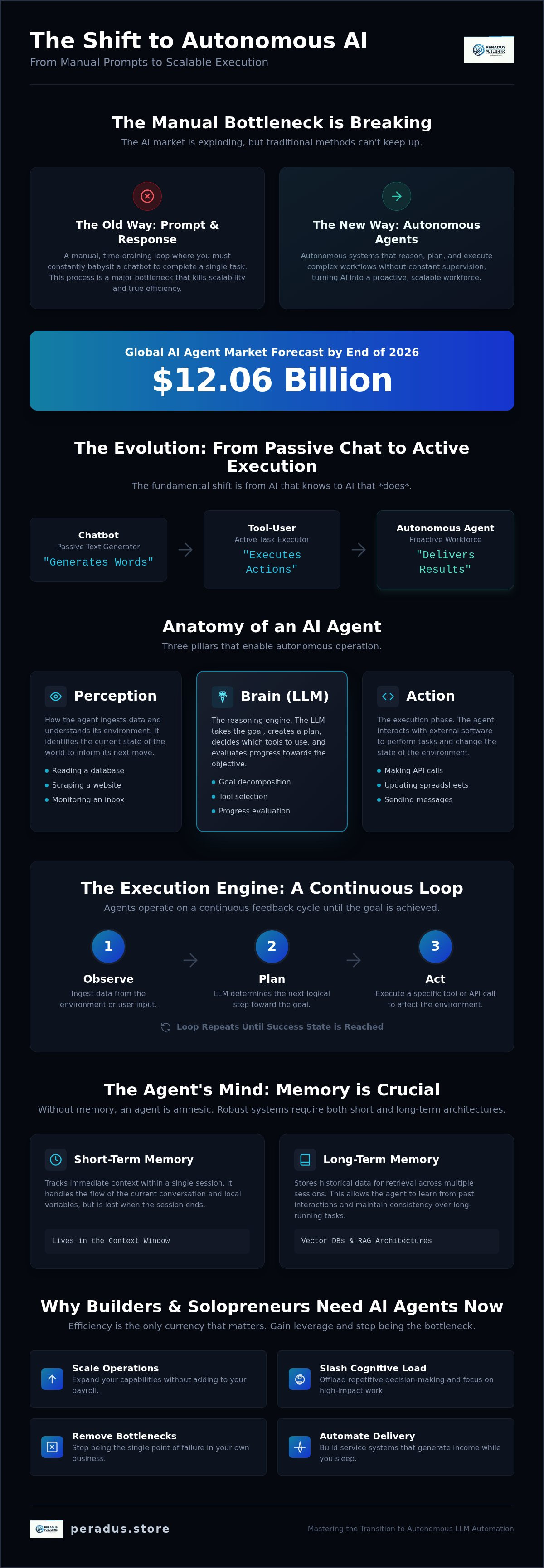
By the end of 2026, the global market for AI agents hit an estimated $12.06 billion. Yet, most developers and business owners remain trapped in a manual "prompt-response" loop that drains time and kills scalability. You've likely felt the frustration of babysitting a chatbot just to get a single task done. It is a bottleneck that stops you from reaching true efficiency. Academic definitions won't help you here; you need systems that execute.
This guide shows you how to master the transition from basic prompting to autonomous LLM automation. We strip away the fluff to focus on functional AI orchestration and multi-agent systems. You will learn to deploy complex workflows using the latest stable frameworks like LangGraph 1.2.11 and CrewAI 0.80+. We provide the condensed expertise needed to skip the corporate noise and build real solutions. Premium quality at $27.99. No upsells, no subscriptions. Get ready to turn AI from a simple digital assistant into a fully autonomous workforce.
Key Takeaways
- Move beyond passive chat interfaces. Learn to build active task executors that use the "Observe-Plan-Act" cycle for autonomous reasoning.
- Optimize performance with advanced memory management. Use short-term and long-term memory to ensure your systems handle complex, multi-step workflows.
- Scale your operations using multi-agent systems. Discover how to coordinate specialized roles through professional AI orchestration.
- Deploy your first functional agentic workflow today. Map specific problem success states and integrate the necessary data access points with precision.
- Master the transition to autonomous AI agents. Stop babysitting prompts and start executing high-impact LLM automation at scale.
From Chatbots to AI Agents: Why Autonomous Systems Are the Future
Stop chatting. Start executing. The era of the passive chatbot is dead. We've moved into the age of AI agents. These aren't just text generators that spit out paragraphs on command. They are autonomous systems that use Large Language Models (LLMs) to reason, plan, and perform real-world actions. You don't need a bot that talks; you need a system that works.
The "agentic" shift is a fundamental change in how we use technology. Instead of you working the tool, the tool works for you. An Intelligent agent perceives its environment, processes goals, and interacts with external software to get things done. This is the core of LLM automation. It turns a static model into a dynamic workforce. It's the backbone of the next generation of digital products. It moves AI from a sidekick to a lead performer.
A text generator is a toy. A tool-user is a professional asset. Generators give you words; agents give you results. When you integrate LLM automation, you bridge the gap between "knowing" and "doing." This is why autonomous systems are the future. They don't wait for your next prompt. They iterate until the success state is reached. They manage the complexity so you don't have to. Success depends on orchestration, not just better prompting.
The Core Components of Agentic AI
Building an agent requires three distinct pillars. 🧠
- Perception: This is how your agent ingests data. It could be reading a database, scraping a website, or monitoring an email inbox. It identifies the current state of the world.
- Brain: The LLM serves as the reasoning engine. It takes the goal you set and initializes a plan. It decides which tools to use and when. It evaluates progress.
- Action: This is the execution phase. The agent makes API calls, updates spreadsheets, or sends messages. It doesn't just suggest a response. It executes the task.
Why Solopreneurs Need AI Agents Now
Efficiency is the only currency that matters for builders. 🚀
You can scale operations without adding a single person to your payroll. By offloading repetitive decision-making to AI agents, you slash your cognitive load. You stop being the bottleneck in your own business. This allows you to build automated service delivery systems that generate income while you sleep. It's about leverage. High-impact builders are already using LLM automation to replace entire departments. You don't need a massive enterprise budget or complex subscriptions. Our AI Agents Ebook provides the exact roadmap you need. Premium quality at $27.99. No upsells, no subscriptions. Skip the corporate noise. Start building today.
The Mechanics of LLM Automation: How AI Agents Execute Tasks
Execution isn't magic. It's a loop. Technical builders call this the "Observe-Plan-Act" cycle. It functions as a continuous feedback mechanism that powers modern automation:
- Observe: The agent ingests data from the environment or user input.
- Plan: The LLM determines the next logical step based on the goal.
- Act: The system executes a specific tool or API call.
This loop repeats until the success state is reached. It's the technical core of how AI agents operate without your constant supervision. By automating the decision-making process, you move from manual prompting to scalable execution.
Building a reliable system requires sophisticated memory management. Short-term memory lives in the context window. It tracks the immediate conversation flow and local variables. Long-term memory uses vector databases or RAG architectures. It stores historical data for future retrieval across different sessions. Without both, your agent is amnesic. High-performance systems require robust memory architectures to maintain consistency over long-running tasks.
Think of LLM automation as the bridge. It translates natural language intent into raw code execution. You describe the goal; the LLM generates the function call. This removes the friction between human logic and machine execution. It's why a survey of LLM-based multi-agent systems highlights reasoning as the primary driver of modern task execution. Complex tasks fail without goal decomposition. You must break big objectives into sub-tasks. Each sub-task becomes an executable step. This granular approach ensures reliability and prevents the system from drifting off-course.
Reasoning Paradigms: ReAct and Beyond
Adopting the ReAct framework provides a solid foundation for AI orchestration. It stands for Reason and Act. The agent thinks before it does. It generates a thought trace. Then it selects a tool. If the tool output is unexpected, the agent self-corrects. It analyzes the error and tries a different path. This iterative reasoning makes the system resilient. LLM automation is the engine of autonomous task routing.
Tool Use and API Integration
Tools give AI agents hands. 🛠️ You enable them to interact with the real world through APIs. Web search, SQL databases, and email servers are the levers of power. But with power comes risk. Giving agents write-access to your systems has serious security implications. You must implement strict tool definitions and validation layers. Standardizing these definitions ensures your agent doesn't hallucinate a command that breaks your infrastructure. We've mapped these patterns in our guide to save you time. Premium quality at $27.99. No upsells, no subscriptions. If you need help architecting these secure connections, reach out to our specialists for a technical consultation.
Multi-Agent Systems vs. AI Orchestration: Choosing Your Framework
Single agents are fine for basic tasks. Complex business logic requires multi-agent systems. This is where specialized agents collaborate to solve problems that a generalist model would fail to handle. One agent researches. Another writes code. A third audits the output. Specialized agents consistently outperform generalists in production because they operate within tighter constraints. They don't get distracted by irrelevant data.
AI orchestration is the management layer. It's the conductor of your digital workforce. You aren't just prompting; you're architecting a hierarchy. Manager agents oversee the entire process. They delegate sub-tasks to Worker agents. This structure ensures that every action aligns with your high-level goal. It reduces hallucinations and keeps the workflow on track. Success depends on how well you manage these interactions, not just the quality of your LLM.
Specialization is the key to scaling LLM automation. When you build with AI agents, you assign specific personas. A "Legal Auditor" agent has different instructions and tool access than a "Content Creator" agent. This division of labor allows for deeper reasoning and more accurate execution. It turns a simple chat interface into a professional-grade automation engine.
Designing Multi-Agent Workflows
Assign specific personas and strict constraints to every agent in your system. Communication protocols must be structured. Agents should pass validated data, not just raw text, to maintain reliability. You must also implement guardrails to avoid infinite loops. Without a "max iterations" limit, agents can get stuck in a recursive loop of feedback. This wastes tokens and stalls your workflow. Precision in your design prevents these technical bottlenecks.
Top Frameworks for AI Orchestration
Pick your tools based on the complexity of your goal. LangGraph 1.2.11 is the gold standard for stateful, cyclic workflows. It gives builders total control over the execution graph. CrewAI 0.80+ is excellent for role-based multi-agent patterns. It simplifies the process of defining how agents collaborate. While no-code tools offer a fast start, they hit a ceiling quickly. Code-first frameworks provide the flexibility needed for enterprise-grade AI orchestration. You need the power to customize every interaction. We've mapped these patterns to help you skip the corporate noise. Premium quality at $27.99. No upsells, no subscriptions. Build systems that actually deliver results.
Practical Implementation: Building Your First Agentic Workflow
Building AI agents isn't about writing better prompts. It's about engineering a reliable process. You need a structured roadmap to move from a concept to a functional deployment. Follow these four steps to build your first agentic workflow today.
- Step 1: Define the Success State. Don't start with code. Start with the outcome. What exactly is the agent supposed to achieve? If you can't define a binary success state, your agent will drift. Clear goals lead to reliable execution.
- Step 2: Map Tools and Access. Identify the "hands" your agent needs. Does it need SQL access? A Gmail API? A web scraper? List every data point the agent must ingest to make an informed decision.
- Step 3: Framework Selection. Choose your engine. For stateful, complex logic, use LangGraph 1.2.11. For role-based collaboration, use CrewAI 0.80+. Match the tool to the complexity of the task.
- Step 4: HITL Verification. Production systems require a Human-in-the-loop (HITL). Implement a pause in the workflow. Let a human review the agent's plan before it executes a high-stakes action. This is the difference between a tool and a liability.
Setting Constraints and Guardrails
Autonomous systems can hallucinate. You must implement strict guardrails to maintain accuracy. Set a hard token budget to prevent runaway loops that drain your wallet. Use stop conditions. If the agent doesn't reach success within five iterations, force a shutdown. This keeps your LLM automation efficient and cost-effective. Without these limits, your operational costs will skyrocket without delivering value.
Testing and Iterating Your Agent
Debugging a multi-agent system is different from standard software. You aren't just checking code; you're checking reasoning. Use reflection patterns. Force the agent to critique its own output before finalizing. Testing AI orchestration with edge cases is the only way to ensure production stability. Watch for failures in tool validation. Refine the persona if the logic breaks. Success in 2026 depends on these iterative cycles.
Premium quality at $27.99. No upsells, no subscriptions. Our ebook gives you the blueprint for these deployments. If you need a custom implementation for your business, book a technical build session with our team today. Skip the corporate noise and start building.
Master AI Orchestration: The AI Agents Ebook for Builders
Theoretical knowledge has a ceiling. To break through, you need the mechanics of execution. The AI Agents Ebook is the definitive manual for technical builders. It cuts through the hype. It focuses on the reality of AI agents in production. Anastasios Perachoritis distilled 15+ years of enterprise data expertise into this guide. You get the same strategies used at the highest levels of AI governance. Skip the corporate noise. Get the blueprint.
Most resources stay at the surface level. We go deep into LLM automation. You've seen the frameworks like LangGraph and CrewAI in the previous sections. Now, learn the secrets of stable deployment. This guide ensures your systems don't just run; they scale. It's the difference between a prototype and a production-grade product. We focus on the reasoning and the execution with equal intensity. You build with confidence.
What’s Inside the AI Agents Ebook?
This isn't a collection of prompts. It's an engineering guide. 🛠️
- Multi-agent systems architecture. Master the hierarchy of manager and worker agents.
- AI orchestration for solopreneurs. Build a digital workforce that handles your heavy lifting.
- Deployment Blueprints. Move from local experiments to robust, live environments.
- Error Handling and Reflection. Implement loops that self-correct and improve over time.
- Immediate ROI. Every chapter includes actionable steps you can implement tonight.
We've stripped away the narrative fluff. You get high-impact content designed for rapid scanning. Every page is a tool. Every section is a shortcut to mastery. This is the condensed expertise you need to dominate the agentic era. Premium quality at $27.99. No upsells, no subscriptions.
Take Action Today
The market is shifting fast. Corporate theory is a distraction. Every day you spend stuck in the "prompt-response" loop is a day you lose your competitive edge. You don't need expensive recurring platform fees. You need the knowledge to build your own infrastructure. This one-time purchase gives you early access to the mechanics of the future. 🚀
Stop reading. Start building autonomous systems that work. Get instant access to the guide that delivers results. Secure your copy of The AI Agents Ebook for $27.99. Your transition to a master of AI agents begins now.
Build Your Autonomous Future Today
The transition from simple prompts to autonomous execution is the only way to scale in a competitive digital environment. You've learned how to architect multi-agent systems and implement the "Observe-Plan-Act" cycle for maximum reliability. Now, it's time to stop studying the theory and start deploying functional AI agents that deliver measurable results. Success depends on orchestration, not just better prompting.
This transition doesn't require enterprise budgets or complex software subscriptions. You need the condensed expertise of Anastasios Perachoritis. He brings 15+ years of data governance experience directly to your workflow. Get instant digital delivery and actionable blueprints that cut through the noise. Premium quality at $27.99. No upsells, no subscriptions. The tools are ready; the only variable left is your action.
Build your autonomous future for $27.99; download The AI Agents Ebook now.
Frequently Asked Questions
What is the difference between an AI chatbot and an AI agent?
Chatbots answer; AI agents act. A chatbot provides information based on a prompt, while an AI agent uses reasoning to execute multi-step workflows across external tools. Agents use the "Observe-Plan-Act" cycle to achieve specific goals autonomously. They don't just talk; they perform API calls, update databases, and manage complex logic without manual intervention. This shift from passive to active defines the modern agentic era.
Do I need to be a developer to build multi-agent systems?
No, but a technical mindset is essential. While code-first frameworks like LangGraph 1.2.11 offer the most control, several no-code platforms allow you to orchestrate agents using visual builders. However, understanding logic flow, tool integration, and data validation is crucial for success. Our guide breaks down these complex concepts into actionable steps that anyone with basic technical fluency can follow to deploy functional systems today.
How much does it cost to run AI agents daily?
Costs vary based on token usage and model selection. Running lightweight models for simple tasks can cost pennies, while high-volume, multi-agent workflows using frontier models may reach several dollars per day. Efficient architecture is key. By implementing strict guardrails and budgeting token usage, you can keep operational expenses low. The global AI agent market value hit over $10 billion in 2026 because the ROI far outweighs these minor fees.
Can AI agents operate without human supervision?
Yes, they can operate autonomously, but production-grade systems require human-in-the-loop (HITL) verification. Full autonomy is possible for low-risk tasks like data scraping or internal categorization. For high-stakes actions like sending payments or external emails, we recommend a human review step. This ensures accuracy and prevents runaway errors. Strategic AI orchestration involves setting clear "stop" conditions to maintain absolute control over your automated workforce at all times.
What are the best tools for AI orchestration in 2026?
LangGraph 1.2.11 and CrewAI 0.80+ are the current industry standards for builders. LangGraph excels at stateful, cyclic workflows where agents must revisit previous steps. CrewAI is the go-to for role-based multi-agent patterns, allowing you to assign specific personas to individual agents. These frameworks provide the stability and scalability needed for enterprise-grade automation. Choosing the right tool depends on whether you need simple task routing or complex, collaborative reasoning.
What happens if an AI agent makes a mistake in a workflow?
Reliable systems use reflection and self-correction loops to handle errors. When an agent receives an unexpected tool output, it analyzes the failure and attempts a different path. This iterative reasoning is a core feature of the ReAct framework. If the agent cannot resolve the issue within a set number of iterations, it triggers a "stop" condition. This prevents infinite loops and allows a human to intervene before any damage occurs.
Is LLM automation safe for handling sensitive business data?
Safety depends on your implementation and adherence to regulations like the EU AI Act or California's AI Transparency Act. You must use secure API connections and implement strict data governance policies. Avoid giving agents broad write-access to core systems without validation layers. By following enterprise-grade security protocols, you can leverage LLM automation to process data safely. Our ebook covers these governance essentials to help you build with total confidence.
How does the AI Agents Ebook help beginners get started?
It removes the noise and provides a fluff-free roadmap to mastery. We skip the academic jargon to focus on practical, real-world results you can achieve tonight. You get the condensed expertise of Anastasios Perachoritis, focused specifically on building and orchestrating multi-agent systems. Premium quality at $27.99. No upsells, no subscriptions. It is the most efficient way to move from simple prompting to deploying your first autonomous workforce with zero friction.

